
A Fresh Perspective on Understanding and Resolving Anger
When someone is angry, what is actually happening in their mind? Why does anger sometimes persist long after an upsetting experience has ended? And how might our understanding of anger change the way we meet with people experiencing it?
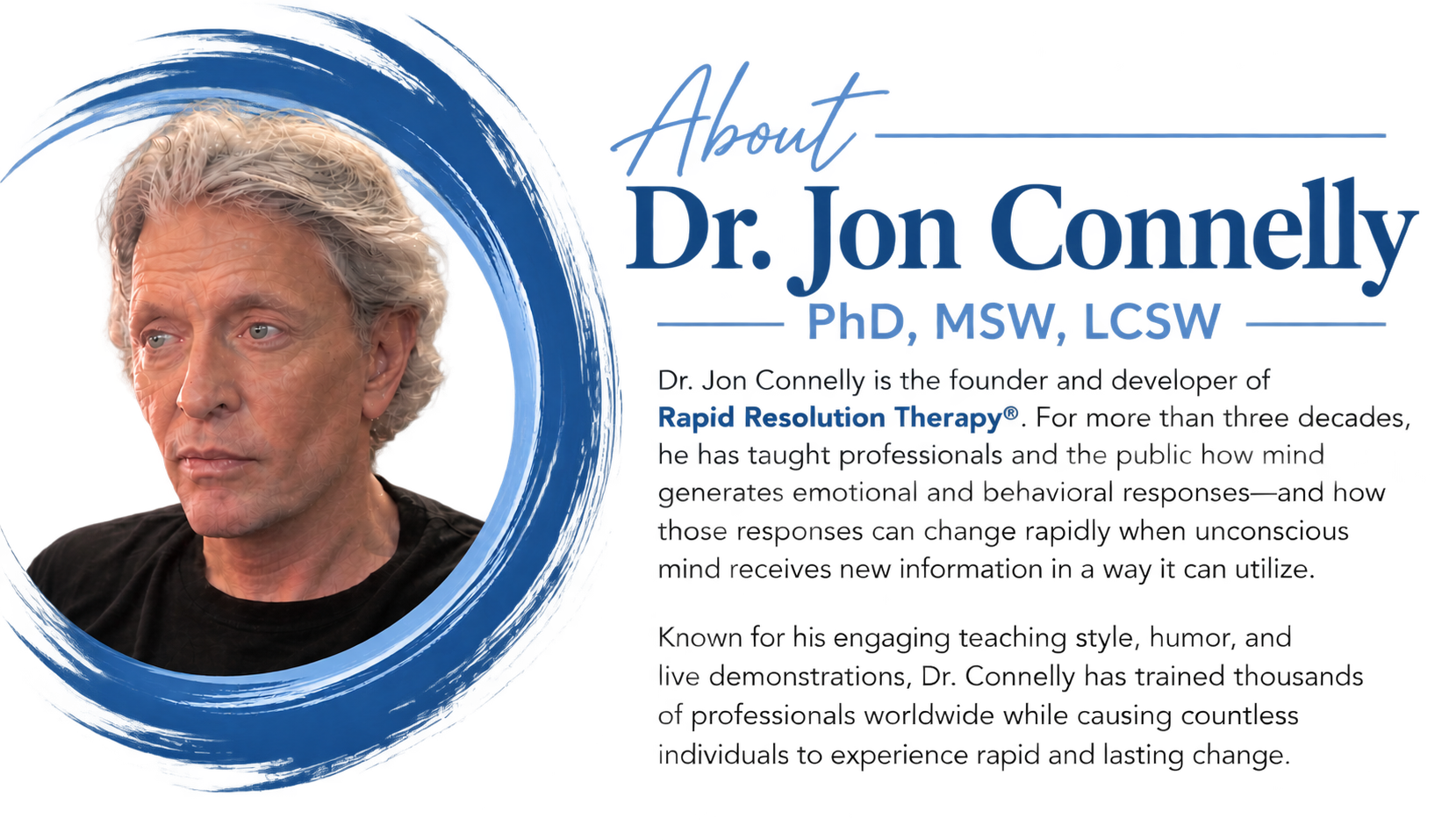
Join Dr. Jon Connelly, founder of Rapid Resolution Therapy (RRT), for an engaging 6-hour training exploring a fresh perspective on anger and the processes that generate and maintain unwanted emotional responses.
Designed for mental health professionals, counsellors, social workers, coaches, and anyone interested in understanding and resolving anger, this training introduces a different way to think about anger and approach conversations with people who are experiencing it.
Through engaging instruction, filmed case demonstrations, and interactive learning, participants will explore how RRT approaches anger, why conventional assumptions may not always be useful, and how clarity can create opportunities for more effective responses.
No previous experience with Rapid Resolution Therapy is required.

EVENT DETAILS
Date: Tuesday, January 26, 2027
Time: 10:00 AM – 5:00 PM EST
Registration: $197
RRT Members: FREE

Understanding Anger From A Different Perspective
Anger is often understood as a response to perceived threats, injustice, frustration, or mistreatment. Anger can also seem necessary. People may believe anger motivates action, establishes boundaries, protects against future harm, or ensures that wrongdoing is not overlooked.
But does effective action require anger?
And why might someone continue experiencing anger long after the situation that originally triggered it has ended?
Rapid Resolution Therapy introduces a different conceptual framework for examining these questions.
From the RRT perspective, anger is an automatic response generated by the mind based on how information is being processed. Rather than focusing exclusively on managing the emotional response, RRT explores the processes that may be contributing to its continuation.
This training examines those concepts and demonstrates how they may influence the way professionals understand and communicate with people experiencing anger.

What If There Were Another Way to Approach Anger?
You've likely met with someone who knows exactly why they're angry. They can describe what happened, who was responsible, and why their reaction makes sense. Perhaps you've explored the experience together, identified triggers, discussed coping strategies, and worked toward healthier responses.
Yet the anger remains.
For mental health professionals, these conversations can sometimes feel repetitive. Even with a strong therapeutic relationship and thoughtful interventions, progress may be difficult to achieve.
What if a different understanding of anger could change the direction of the conversation?
Rapid Resolution Therapy introduces a distinctive perspective on how the mind generates emotional responses and why those responses may continue long after the original circumstances have passed. Rather than focusing exclusively on managing anger, RRT explores the processes that may contribute to its persistence.
This training offers an opportunity to examine that perspective, observe its application in filmed clinical demonstrations, and consider how it may inform meeting with individuals experiencing anger and resentment.

What People Are Saying about RRT…
“My clients love this approach and enjoy its use of multi-level communication. As my clients share their successes with others, referrals began to pour into my practice, nearly doubling it in a year’s time."
Courtney Armstrong, LPC, NBCFCH
Published Author of Rethinking Trauma Treatment
What You'll Explore:
How Anger Works
Examine anger as an emotional and physiological response to perceived threats, frustration, injustice, and conflict. Explore the relationship between automatic responses, interpretation, and behavior through the RRT framework.
Why Anger Persists
Identify factors that may contribute to persistent anger and resentment, including repetitive thinking, perceived injustice, and beliefs about the necessity of remaining angry.
Anger, Clarity & Effective Action
Explore common assumptions about the role of anger in motivation, protection, boundaries, and accountability. Consider the distinction between emotionally reactive behavior and purposeful action.

A Different Approach to Communication
Examine how RRT uses language, metaphors, questions, and perspective shifts when meeting with individuals experiencing anger. Consider how these approaches may influence the direction of therapeutic conversations.
RRT in Action
Watch selected filmed case demonstrations and examine the communication strategies and interventions used. Through guided discussion, participants will identify RRT concepts illustrated in the sessions and consider their potential applications and limitations in clinical practice.
What Makes This Training Different?
This training focuses on how anger and resentment can stop being generated not how they are managed, suppressed, or expressed.
Participants will view filmed clinical demonstrations showing how shifts in internal processing change emotional intensity, physiological activation, and behavioral impulse. Recordings are paused throughout to explain how specific practitioner communication and timing influence these shifts and lead to resolution.
The emphasis is on understanding how meaning, perception, and action-signaling drive emotional responses—and how precise changes in these processes produce durable results.
This is a live, interactive, and immersive training designed to keep your mind actively engaged in recognizing change as it happens, rather than passively absorbing information.
The way we understand a problem influences the questions we ask, the conversations we have, and the approaches we consider. For mental health professionals working with people experiencing anger, examining a different conceptual framework may offer new perspectives on familiar clinical challenges.
Join Dr. Jon Connelly for six hours of engaging instruction, filmed case demonstrations, and interactive learning exploring the Rapid Resolution Therapy approach to understanding and addressing anger.
An opportunity to learn, observe, question, and expand the way you think about anger.
Course Information and Registration
Tuesday, January 26, 2027
10:00 AM - 5:00 PM EASTERN
(Includes Breaks)
Time Zone Converter
Investment: $197
RRT Members: FREE
Can’t attend live? Class recording and self paced option will be available. Live attendance is required to qualify for CE credit.
BONUS!!
Receive a FREE 3-hour self-paced course on
Ethics & Malpractice Issues
Presented by Cathy Hoort, JD, and Alan Bader, PhD
Get the link and a unique promo code in the confirmation details!

-
If you have a scheduling or time zone conflict, this course is now available in a self-paced, recorded version. You will be provided with exclusive access to the videos and periodic notes from each session. All participants seeking CE credit must attend the entirety of the program in its live format. The recording version is not approved for credit.
-
Replays become available 72 hours after each session and remain available until three weeks after the close of the program. Please note that this does not include a lifetime availability.
-
For a certificate of attendance from RRT, you must complete the entire program through the live version or document your completion of the replays. Documentation forms will be provided along with the replay of the video. If you are seeking CE credit, you must attend the live version in its entirety in order to receive a certificate of attendance.
-
Yes! This training counts toward the 40 hours of RRT training generally required for membership eligibility and can also contribute toward the training hours needed for the RRT certification track.
RRT Membership is available after completing 40 hours of RRT training, unless otherwise stated. Membership provides access to additional training, resources, and opportunities to further develop your understanding and application of RRT.
-
Absolutely! We understand that investing in your professional growth is a big decision. Our flexible payment options are designed to make this transformative training accessible, so financial constraints don't stand between you and your growth. If you would like to arrange a payment plan, please contact info@rapidresolutiontherapy.com.
-
A full refund is available up to seven (7) days prior to the training start date. After that time, registrants are responsible for the full training fee. To cancel, request a refund, or arrange for a substitute, please contact us at (800) 587-2623 or info@rapidresolutiontherapy.com.
We also offer a Satisfaction Guarantee so you can attend the beginning of the training and determine if it is a good fit.
For single-day trainings, refund requests must be made within the first hour of the training.
For multi-day or multi-session trainings, refund requests must be made by the end of the first day of training.
If a refund is requested within these timeframes, a full refund will be issued. After these periods have passed, participation is considered accepted and refunds will no longer be available.